
AFWA Bangladesh Calls for Immediate Formation of a Minimum Wage Board to Reassess Garment Workers’ Wages
11 August 2026
“BDT 12,500 Is Not Enough for a Dignified Life”
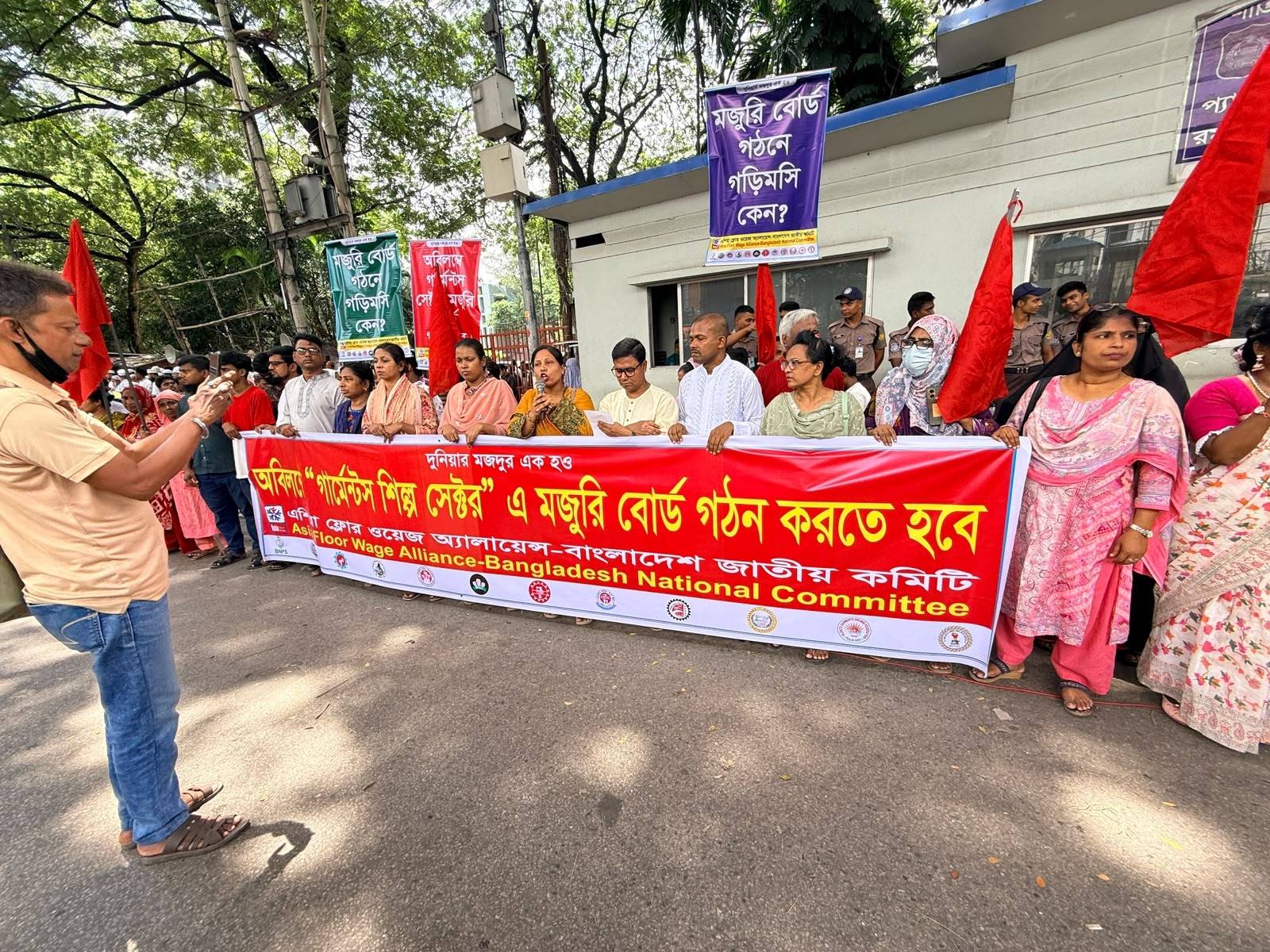
The Asia Floor Wage Alliance (AFWA) Bangladesh Committee has called for the immediate formation of a new Minimum Wage Board to reassess the existing minimum wage for workers and employees in Bangladesh’s ready-made garment (RMG) industry.
The leaders of AFWA Bangladesh stated that, in the face of rising living costs, inflation, and the uncontrolled increase in the prices of essential commodities, the current minimum wage of BDT 12,500 is insufficient even to meet the basic needs of a garment worker and their family.
The demand was raised at a rally organised in front of the National Press Club at 11:00 a.m. on Tuesday, 11 August. Following the rally, letters were submitted to the Honourable Prime Minister and the Minister of Labour and Employment calling for the immediate formation of a Minimum Wage Board to reassess the wages of garment workers.
The rally was chaired by Kazi Ruhul Amin, Convener of the AFWA Bangladesh Committee and General Secretary of the Bangladesh Garments and Sweaters Workers Trade Union Centre. The rally was moderated by Nahidul Hasan Nayan, Member of the AFWA Bangladesh Committee and General Secretary of the Sommilito Sramik Federation.
Speakers at the rally included Sultana Begum – Member Secretary of the AFWA Bangladesh Committee and President of the Green Bangla Garments Workers Federation, Mohammad Ilias – General Secretary of Green Bangla Garments Workers Federation, Freedom Fighter Abul Hossain – President of the Textile Garments Workers Federation, Rafiqul Islam Sujon – President of the Bangladesh Garments and Industrial Workers Federation, Shamima Akter – President of the Bangladesh Garments Labour Congress, Golam Mostofa – Vice-President of the Bangladesh Garments Trade Union Federation, Yahya Khan – Vice-President of the Sommilito Sramik Federation, Rashida Akter – Convener of the AFWA Bangladesh Women’s Leadership Committee, Jahanara Begum – Member of the AFWA Bangladesh Women’s Leadership Committee; Billal Hossain, President of the Gazipur District Committee of the Alokito Garments Workers Federation, and leaders of various workers’ organisations.
The speakers stated that the RMG industry plays a vital role in Bangladesh’s economy. The sector makes a significant contribution to the country’s export earnings, foreign exchange generation, employment, and, in particular, the economic and social empowerment of women. However, they noted that one of the key foundations of the industry’s success has been the cheap labour of millions of workers.
They said that although enormous wealth has been generated in the garment industry through the years of labour and sweat of workers, workers are not receiving their fair share of the wealth they create. While some factory owners have accumulated substantial wealth through the industry, the expected improvement in workers’ living standards has not been achieved.
The speakers emphasised that, “A wage increase is not an act of charity or favour. The fundamental issue is ensuring that workers receive their fair share of the wealth they produce.” According to the speakers, workers’ wages must be sufficient to meet basic needs such as food, housing, healthcare, education, clothing, and transportation, while also enabling them to live a dignified life with their families.
The speakers further stated that, in recent years, the prices of food, rent, fuel, electricity, gas, transportation, education, healthcare, medicines, and almost all other essential commodities have increased significantly. However, garment workers’ incomes have not increased proportionately. As a result, a large portion of workers’ monthly income is spent on rent and food. Worker leaders also stated that many families are becoming increasingly indebted while trying to meet the costs of their children’s education, healthcare, clothing, transportation, and other essential expenses.
The speakers noted that this year, conflicts in the international arena and instability in global markets have created additional pressure on fuel, transportation, and commodity prices, which has also affected working people in Bangladesh. Consequently, the existing wage structure is no longer consistent with the realities of workers’ lives. The rally also highlighted a comparison between the proposed new pay structure for government employees and the wages of garment workers.
The speakers said that under the proposed new pay structure for government employees, the minimum salary is being considered at BDT 20,000. In contrast, workers employed in the RMG sector, one of the country’s principal export industries currently receive a minimum wage of only BDT 12,500.
Worker leaders questioned why, if the cost of food, housing, healthcare, and other living expenses is taken into consideration when revising the salaries of government employees, the same realities are not considered when determining the wages of garment workers – the principal contributors to the country’s export earnings.
They demanded that the government adopt a policy to ensure income levels consistent with the cost of living and inflation for working people across both public and private sectors.
The speakers further stated that many workers are being compelled to work regular overtime because their current wages are insufficient to cover household expenses. Working for long hours beyond normal working hours is putting workers’ physical and mental health at risk. At the same time, the inability to spend sufficient time with their families is having a negative impact on family life.
Worker leaders said that when a worker’s regular working-hour wages are insufficient to meet the basic needs of their family, dependence on overtime becomes inevitable. According to them, improving workers’ living standards requires a wage structure that allows workers to meet their basic needs through income earned during normal working hours, without being forced to work excessive overtime.
The speakers referred to Section 139(6) of the Bangladesh Labour Act, 2006, stating that the law provides for the periodic review and reassessment of minimum wages. Therefore, they said, there is no reasonable justification for any further delay in establishing a new Minimum Wage Board under the current circumstances.
They called for immediate action to reassess wages, taking into consideration workers’ living costs, inflation, industry productivity, employers’ capacity to pay, and the contribution of garment workers to the national economy. The speakers also rejected claims that increasing workers’ wages would destroy the industry. Rather, they argued that fair wages can improve workers’ living standards while also increasing productivity, workplace stability, and the industry’s ability to retain workers.
They emphasised that, in order to ensure the long-term competitiveness of Bangladesh’s garment industry in the international market, the sector must move away from its dependence on low wages. A sustainable and humane garment industry must be built by ensuring workers’ rights, fair wages, safe working conditions, and social protection.
Demands Raised by AFWA Bangladesh
The AFWA Bangladesh Committee put forward the following demands to the government:
- Immediate formation of a new Minimum Wage Board to reassess the existing minimum wage of garment workers;
- Determination of a wage sufficient for a dignified life, based on the actual cost of living;
- Ensuring genuine and independent representation of workers on the Minimum Wage Board;
- Reviewing the wage structure in line with inflation and increases in the prices of essential commodities;
- Ensuring job security, workplace safety, occupational health, maternity benefits, and social protection for workers;
- Ensuring the effective exercise of workers’ right to form and join trade unions; and
- Holding international garment brands and buyers accountable for ensuring fair wages and workers’ rights throughout their supply chains.
Statement by Kazi Ruhul Amin
In his concluding remarks, Kazi Ruhul Amin, Convener of the Alliance and a prominent labour leader, called for the formation of a Minimum Wage Board for the garment industry within August 2026. He warned that otherwise, workers would be compelled to launch stronger movements.
He stated that if any disruption occurs to the industry, production, or the economy as a result of such a movement, the responsibility will not lie with the workers; rather, the government and employers will have to bear responsibility.
Strongly criticizing the statement by the President of the Bangladesh Knitwear Manufacturers and Exporters Association (BKMEA) that wages would not be increased before five years, Kazi Ruhul Amin said that employers are not only exploiting workers but are also engaging in condemnable and arrogant behaviour, the consequences of which will not be positive.
Calling upon the government and employers to act responsibly, he urged them to take into account the uncontrolled rise in the prices of essential goods.
He said that workers are the principal force behind the success of Bangladesh’s garment industry. However, if these workers cannot meet the basic needs of their families with their current wages, the country’s economic development cannot be considered sustainable or humane.
He stated:
“Increasing workers’ wages is not a grant or charity. It is their right to receive a fair share of the wealth they produce. A Minimum Wage Board must be formed immediately, taking into account the realities of the cost of living.”
Statement by Sultana Begum
Sultana Begum, Member Secretary of the AFWA Bangladesh Committee, said that the wage crisis facing garment workers has existed for a long time. She emphasised that the sustainability of the industry cannot be ensured by focusing solely on increasing production and exports without guaranteeing fair wages for workers.
She said:
“The garment industry must be made sustainable by ensuring workers’ dignity and rights. No further delay in forming the Minimum Wage Board is acceptable.”
The speakers at the rally warned that continued neglect of workers’ long-standing wage crisis and the rising cost of living could increase unrest within the industry.
They emphasised that ensuring fair wages for workers is not only a matter of workers’ interests; it is also a fundamental prerequisite for maintaining stability and productivity in Bangladesh’s garment industry and protecting its long-term competitiveness in the international market.
The AFWA Bangladesh Committee therefore strongly urged the government to immediately establish a Minimum Wage Board and determine a new, just, and cost-of-living-adjusted wage structure for garment workers.
Submission of Letters to the Government
At the conclusion of the programme, letters were submitted to the Honourable Prime Minister, Government of the People’s Republic of Bangladesh, and the Honourable Minister, Ministry of Labour and Employment, Government of the People’s Republic of Bangladesh, demanding the immediate formation of a Minimum Wage Board to reassess the wages of garment workers.
On behalf of the AFWA Bangladesh Committee, the letter addressed to the Hon’ble Prime Minister, Government of the People’s Republic of Bangladesh, Prime Minister’s Office, Tejgaon, Dhaka, was submitted by Sultana Begum, Member Secretary of the AFWA Bangladesh Committee; Shamima Akter, President of the Bangladesh Garments Labour Congress; and Ankhi, Vice-President of the Sommilito Sramik Federation.
The letter addressed to the Hon’ble Minister, Ministry of Labour and Employment, Government of the People’s Republic of Bangladesh, Bangladesh Secretariat, Dhaka, was submitted on behalf of the AFWA Bangladesh Committee by Nahidul Hasan Nayan, General Secretary of the Sommilito Sramik Federation; Sumaiya Islam, General Secretary of the Bangladesh Garments and Industrial Workers Federation; and Dipak Shil, leader of the Bangladesh Garments and Sweaters Workers Trade Union Centre.