
Sri Lanka’s Second People’s Tribunal Examines Wages and Working Conditions in the Garment Industry
SRI LANKA — MONDAY, 5 OCTOBER 2026
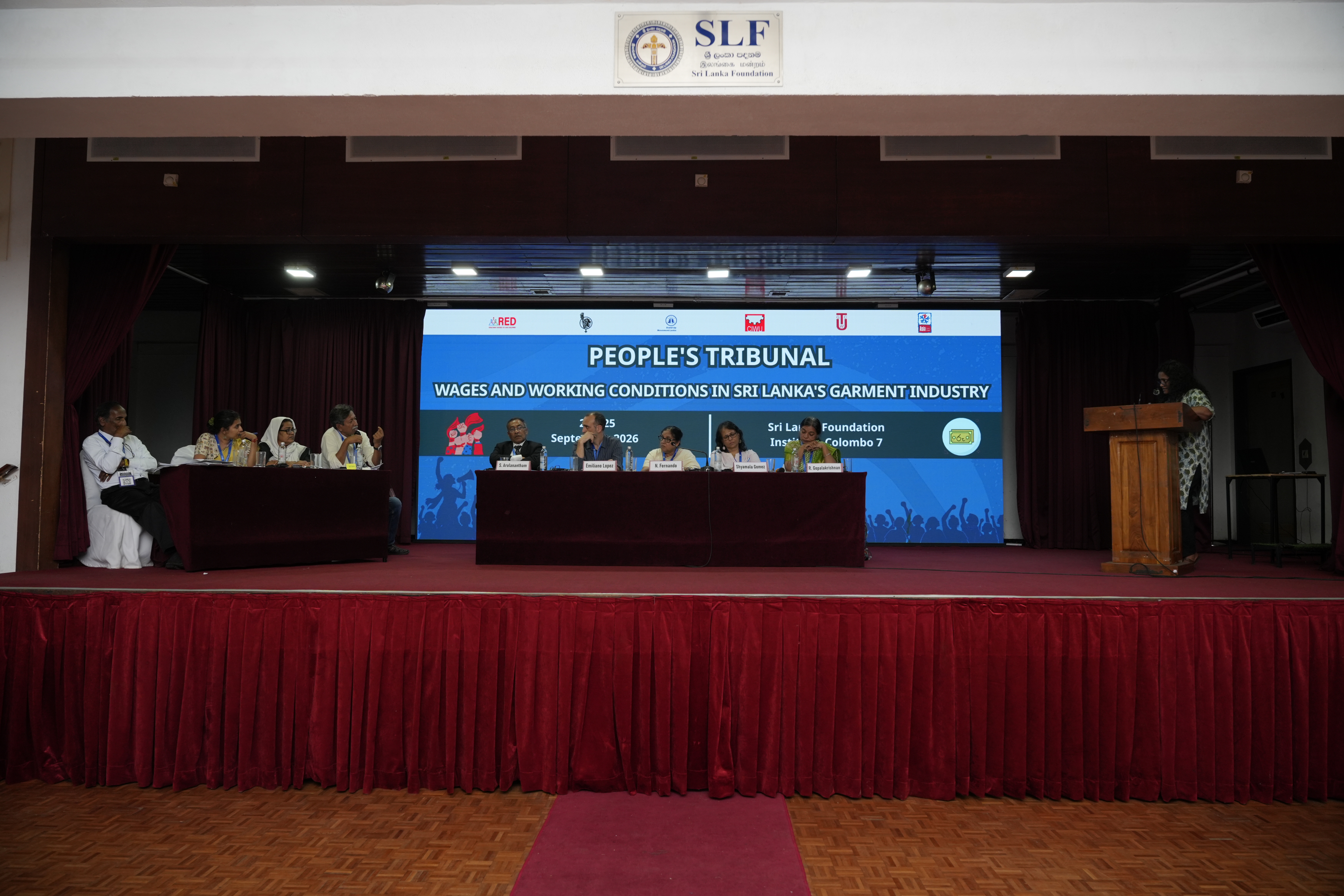
On 24 and 25 September 2026, Asia Floor Wage Alliance Sri Lanka convened the People’s Tribunal: Wages and Working Conditions in Sri Lanka’s Garment Industry at the Sri Lanka Foundation Institute, Colombo 7. The first Sri Lanka People’s Tribunal was held on 27 and 28 March 2011 in Negombo, where garment workers testified on living wages and decent working conditions as fundamental human rights. Fifteen years later, the Tribunal returned to these questions as workers continue to face wages and working conditions that fall far short of a dignified standard of living.
The 2026 Tribunal brought together garment workers, trade union leaders, labour lawyers, economists, researchers and civil society members. It was convened as a platform for workers and experts to provide testimony on wages and working conditions, including poverty-level wages, the structural undervaluation of women’s work, compelled overtime, and workers’ wage vulnerability during economic and climate crises.
On the first day, seven garment workers testified on wages, working conditions, workplace experiences, labour rights, and the implementation of labour law from across sectors from different parts of the country. Their accounts described inadequate wages, production-target pressure, dependence on overtime and attendance incentives, difficulty obtaining leave, restrictions on washroom and drinking-water breaks, wage deductions and retaliation in response to trade union activity.
One garment worker, who produced garments for Nike, Calvin Klein and Victoria’s Secret, had this to say about her working conditions, “I faced so many issues, especially wage-related issue. There was so much work. But I didn’t get my wages. I was overloaded with work – and dealing with target pressure as well.”
The testimony was heard alongside wider evidence on the gap between wages and the cost of a dignified life for garment workers and their families. AFWA’s 2024 Consumption Survey covered 467 garment workers across 20 factories in Sri Lanka. It recorded an individual monthly income of LKR 33,500, an average monthly expenditure of LKR 88,803, and a living wage benchmark of LKR 158,353.45. The reported monthly wage therefore amounted to just 21 per cent of the living wage benchmark.
Submissions were presented by Dr. Amali Wedagedara and Thahira Cader. The People’s Advocates, Ashim Roy, Leon Joseph and Swasthika Arulingam, examined the evidence and situated workers’ experiences within questions of labour rights, freedom of association, collective bargaining and garment supply chains.
On the second day, AFWA International Coordinator and one of the experts at the event, Wiranta Ginting placed Sri Lanka within AFWA’s regional evidence on poverty wages across Asian garment-producing countries. He reiterated a central principle of AFWA’s living wage methodology: workers should be able to meet their own needs and that of their families within normal working hours, without needing excessive overtime.
The judicial panel comprised Professor A. Sarveswaran, Professor in Private and Comparative Law at the Faculty of Law, University of Colombo and a member of the Cabinet-appointed Committee drafting the new Employment Act; Dr. Nimalka Fernando, Attorney-at-Law, feminist and human rights defender with decades of experience in labour rights, women’s rights and economic justice; Dr. Emiliano Lopez, Chief Economist at the Tricontinental Institute for Social Research and Associate Researcher at CONICET; Ramapriya Gopalakrishnan, Senior Advocate at the Madras High Court and labour and employment law practitioner; and Shyamala Gomez, feminist lawyer and Founder and Executive Director of the Centre for Equality and Justice, with extensive experience in gender equality, labour law and workers’ rights.
The Judges’ Deliberation
Following the workers’ testimonies and expert submissions, the judicial panel shared preliminary findings and recommendations. The panel identified serious concerns relating to inadequate wages, arduous working conditions, retaliation against workers seeking to organise, and violations of freedom of association and collective bargaining rights.
The proceedings also made clear that the wage question cannot be reduced to a single monthly figure. As Dr. Emiliano Lopez told the Tribunal, “The money to pay a living wage exists. The industry generates it every year.” He addressed how wages, working hours, and the distribution of value within the garment supply chain are connected.
Recommendations Emerging from the Proceedings
Shyamala Gomez urged that labour-law reform take an intersectional approach that incorporates the economic conditions facing women workers and unpaid care work. Her intervention stressed that labour issues must be examined alongside the wider realities shaping women workers’ lives, rather than treated as isolated workplace questions.
Ramapriya Gopalakrishnan recommended that the law establish clear criteria for minimum-wage fixation based on the actual needs of workers and their families. She identified food, housing, clothing, transportation, children’s education, healthcare, electricity, fuel, communication, and other household needs as costs that should be reflected when fixing the minimum wage.
Professor A. Sarveswaran recommended that the progressive achievement of a living wage become part of Sri Lanka’s labour policy. Among his wider recommendations on wages and working time, he stated directly that “it should be part of the labour policy to gradually achieve payment of living wage to the workers.”
Dr. Nimalka Fernando, setting out the framework within which the panel would develop its final findings, emphasised that the Tribunal had to look beyond isolated breaches of labour law to the structures governing workers’ lives. As she stated, “Economic contribution cannot be separated from human dignity. Employment cannot be separated from rights. Economic development cannot be separated from conditions under which people work and live.”
Closing the Tribunal on 25 September, Global Living Wage Day, AFWA South Asia Coordinator Abiramy Sivalogananthan reaffirmed that wages are fundamentally about dignity, justice and the ability of garment workers and their families to live with security and dignity. She concluded that the voices of workers and union leaders must remain at the center of the conversation about wages, labor rights and economic justice.
Additional photos from the event can be accessed here.